
How does the NUBE AWG work?
How does the NUBE AWG work?
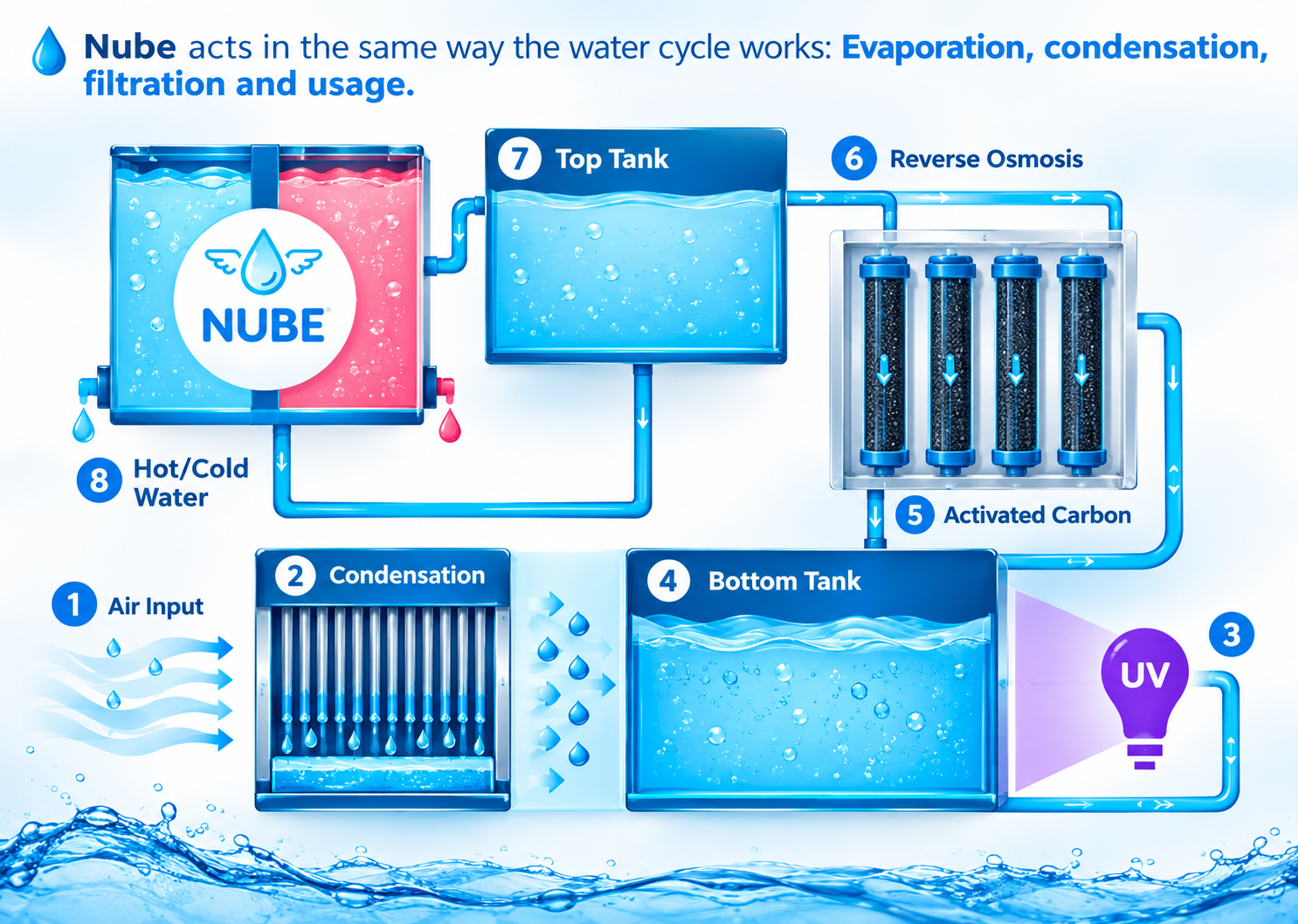
The NUBE system essentially:
1. Takes moisture from ambient air.
2. Condenses the moisture into water.
3. Water is treated with Ultraviolet light to neutralize harmful microorganisms.
4. Water is stored in the the bottom tank.
5. Filters and treats the collected water.
6. Advanced water purification process known as Reverse Osmosis.
7. Water is stored in the the bottom tank.
8. Water is ready for dispensing.
Frequently Asked Questions
Discover how Atmospheric Water Generators work, how water is produced from air, and how MySkyWater solutions can support your home, business, or facility.
Understanding Atmospheric Water Generators
What is an Atmospheric Water Generator (AWG)?
An Atmospheric Water Generator captures moisture naturally present in the air and converts it into water through a condensation and treatment process. AWG technology offers an alternative way to produce water without relying on a conventional water supply line.
How does a MySkyWater AWG work?
The process generally includes five stages:
- Air intake and filtration: Air is drawn into the system and filtered.
- Cooling and condensation: Moisture in the air condenses into liquid water.
- Water treatment: The collected water passes through the system's specified purification stages.
- Mineralization: Minerals may be added according to the system design.
- Storage and dispensing: Treated water is stored and made available for use.
Exact treatment stages and features vary by model.
Does an AWG need a municipal water connection?
No traditional water feed is needed for the atmospheric water-generation process. The system collects moisture from the air. It does require suitable electrical power, adequate airflow, and appropriate environmental conditions.
Can an AWG operate in any climate?
AWGs can operate in many environments, but production depends on relative humidity, temperature, airflow, and the specific equipment. Warm, humid conditions generally provide more moisture to collect. Dry or cold conditions can reduce production.
We recommend evaluating your site's climate and water requirements before selecting a system.
Water Production and Performance
How much water can an AWG produce per day?
Production capacity varies by model and operating conditions. MySkyWater's product lineup includes smaller-capacity systems as well as larger commercial and industrial units.
Published daily production figures are estimates under specified conditions, not guarantees of actual output at every location. Contact us to determine which capacity best matches your expected demand.
What affects daily water production?
Several factors influence performance:
- Relative humidity and ambient temperature
- Available electrical power
- Airflow and equipment placement
- Filter condition and scheduled maintenance
- The selected AWG model and its rated capacity
How much electricity does an AWG use?
Energy consumption depends on the model, its operating conditions, and the amount of water produced. Producing water in less favorable humidity or temperature conditions may require more energy per gallon.
Review the technical specifications for the particular system to estimate energy costs for your location.
Can an AWG supply enough water for a household?
It may be suitable as a household drinking-water source or as part of a broader water strategy. Suitability depends on household demand, climate, available power, storage capacity, and the unit's actual production.
A site assessment can help determine whether one unit or a larger configuration is appropriate.
Water Quality and Filtration
Is water produced by an AWG safe to drink?
Water collected from air must be treated and maintained appropriately before it is consumed. Safety depends on the system's treatment technology, maintenance, storage hygiene, water testing where applicable, and compliance with relevant drinking-water requirements.
Follow the documentation for your specific model and applicable local guidance. Do not assume that water is potable solely because it has been generated from air.
How is the collected water filtered and treated?
AWG systems may combine air filtration, water filtration, and additional treatment stages. Depending on the model, these may include advanced filtration, disinfection, or mineralization.
The exact treatment configuration varies. Consult the specifications for your chosen MySkyWater system to confirm which technologies are included.
Does the system add minerals to the water?
Some AWG models include a mineralization stage designed to add selected minerals to the treated water and influence its taste. Mineralization features and cartridge requirements depend on the model.
Installation and Maintenance
Does an AWG require plumbing?
A standalone unit may not require a municipal water inlet. However, installation needs vary by model. Some systems may require drainage, a dedicated electrical circuit, water distribution connections, or additional storage.
Check the installation guide before choosing a location.
How often do filters need to be replaced?
Replacement intervals depend on the filter type, model, usage, and operating environment. Follow the manufacturer's recommended maintenance schedule and use compatible replacement components.
What routine maintenance does an AWG require?
Routine maintenance may include:
- Replacing filters and cartridges as recommended
- Cleaning designated surfaces and components
- Maintaining hygienic water storage and dispensing areas
- Inspecting ventilation and keeping air intakes unobstructed
- Following scheduled service and water-quality checks
Always follow the maintenance instructions for your particular model.
What electrical connection does an AWG need?
Electrical requirements vary by system. Smaller units may have different voltage requirements from larger commercial and industrial equipment. Confirm voltage, frequency, circuit capacity, and installation requirements using the product's technical documentation.
Commercial, Industrial and Emergency Use
Can businesses and commercial facilities use AWGs?
Yes. Depending on the required output and site conditions, AWGs can be considered for offices, schools, warehouses, industrial facilities, hospitality settings, and other locations that need a local water-generation option.
System sizing should account for peak demand, daily usage, environmental conditions, power availability, and storage.
Can AWGs help during emergencies or water disruptions?
AWG technology may provide an additional source of water where conventional deliveries or infrastructure are disrupted, provided suitable humidity, power, equipment, and maintenance are available.
Actual production can vary significantly, so an AWG should not be assumed to replace a complete emergency water plan in every environment.
Can AWGs work with solar power or battery storage?
Potentially. Solar panels and battery storage may be configured to support an AWG if the electrical system meets the equipment's voltage, power, startup, and operating requirements.
The system designer should account for energy consumption, battery capacity, solar production, and the desired hours of operation.
How do I choose the right MySkyWater system?
Start by considering your expected daily water use, local humidity and temperature, available power, desired storage, installation space, and budget.
MySkyWater can help you identify the questions to address when comparing system capacities and determining whether an AWG is a practical fit for your property or facility.
Still Have Questions?
Let MySkyWater help you explore atmospheric water generation and find a solution that fits your water needs.
Contact MySkyWater
FOLLOW US

COMPANY
CUSTOMER CARE
LEGAL
Copyright 2026. MySkyWater. All Rights Reserved.